
StudySquare
AQA GCSE Higher Maths
The exam board does not endorse this page. The questions in the actual exams might be different. But you can test your knowledge and skills using these resources. You should find answers at the bottom of the page.

Question 1. Provide a prime factor decomposition for 275. [1]
Question 2. Give 0.25252525… as a fraction. Simplify the final fraction. [2]

Question 3. Find a simplified expression for f² + (5f − 2f)². [2]
Question 4. Find the minimum area of a square, given that it has a side of 1 cm to the nearest cm. [2]

Question 5. Simplify the following expression: √12 ÷ √4 × √2. [1]
Question 6. Calculate the value of 1.3 × 10². [1]
Question 7. Given that 25² × 5ˣ ÷ 125 = 625, find x. [2]
Question 8. Simplify the algebraic fraction (x² − 6x + 8) / (x − 2). [2]
Question 9. Expand (2x + 1)(3x + 7). [1]
Question 10. Compare formulas and equations. [2]
Question 11. A kinematic formula is v² = u² + 2as, where v is final velocity, u is initial velocity, a is acceleration and s is displacement. Rearrange this formula to make acceleration the subject. [1]
Question 12. Find the inverse function of f(x) = 3/(x² + 5). [2]
Question 13. Find the value of x such that 3(x + 2) = 12. [1]
Question 14. Donald buys 3 bananas and 2 apples and pays £1.80. When he buys 5 bananas and 1 apple, he pays £2.30. Find the cost of one banana and the cost of one apple. [3]

Question 15. Solve x² − 4x − 40 = 0. [3]
Question 16. Gino owns x number hats. Triple the number of hats Gino owns is greater than the number he would own if he had eight more than he has now. State the possible set of values for x. [2]
Question 17. Using the iterative method, Oliver obtained x₂ after two iterations while solving the equation 3x² + 6x + 12 = 0. Describe the steps he might have taken to arrive at this value. [2]
Question 18. z is directly proportional to s². Given that when s = 3, z = 54, construct an equation for the relationship between z and s². [1]
Question 19. For every dog in an animal shelter, there are two cats. State the fraction of cats in the animal shelter. [1]
Question 20. Anna wants to split £300 between two of her accounts in the ratio 1 : 2. Calculate the amount that each bank account will get. [1]

Question 21. Write down 4/25 as a percentage. [1]
Question 22. Beth has made an investment of £7000. Given that it accrues compound interest of 3% every year, calculate the value of her investment in 4 years. [2]

Question 23. The number of meat-eaters a restaurant hosts daily is inversely proportional to the number of vegetarian dishes they make. Given that when they host 15 meat-eaters, they make 4 vegetarian dishes, calculate the number of vegetarian dishes they will make when they get 20 meat-eaters. [2]
Question 24. A bumblebee flies 100 m at 2.5 m/s and then 50 m at 5 m/s. Calculate the mean speed of the bumblebee. [3]

Question 25. Rachel wants to calculate the density of water in g/cm³. Given that the density of water is 997 kg/m³, derive the value Rachel is looking for. [1]

Question 26. State the conditions for two lines to be perpendicular to each other. [1]
Question 27. Find the points of intersection of the line y = 3x + 5 and the circle centred at the origin with radius 5. [3]
Question 28. State the new coordinates for the point (9, 4) after we translate it by a vector (−2 5). [1]
Question 29. Complete the square of the following expression: x² + 6x + 11. [2]
Question 30. Describe the relationship between consecutive terms in an arithmetic sequence. [1]
Question 31. Name the type of diagram provided in the image. [1]

Question 32. Twenty volunteers have been cleaning a beach. Each of them has collected the following amount of rubbish in kilograms: 7, 4, 3, 2, 5, 2, 7, 5, 4, 3, 6, 5, 5, 4, 7, 3, 8, 4, 6, 5. Find the modal mass of rubbish collected by a volunteer. [1]
Question 33. Find the third quartile for 8, 3, 6, 4, 7, 3, 2, 8, 5, 9, 4, 9, 2, 1, 7, 4, 9, 4. [1]
Question 34. Name the type of correlation in the graph provided. [1]

Question 35. A coin flip with one trial returns an experimental probability of 0% or 100%. How can we change the experiment to get the probability that is closer to 50%? [1]
Question 36. Find the probability of rolling a die to get a number that is not 6. Give your answer as a fraction. [1]
Question 37. What is the probability that four coin flips return exactly two tails and two heads in any order? [2]
Question 38. Calculate the value of θ. [1]

Question 39. Explain why a cylinder has 2 edges but no vertices. [1]
Question 40. A triangle is enlarged by a scale factor of 3. Explain the relationship between the old triangle and the new triangle. [1]
Question 41. Explain why the angle subtended at the circumference by a semicircle is 90°. [2]
Question 42. Calculate the area of a circle with a radius of 6 cm rounded to cm². [1]
Question 43. Lola draws a triangle with a hypotenuse of √18 cm. Given that the other two sides of the triangle are equal, calculate the length of these sides. [2]
Question 44. Zain is making a garland out of triangles. Each triangle has two sides of 8 cm and 10 cm and an angle of 60° opposite a side of unknown length. Calculate the length of the third side. [2]
Question 45. Mary is cutting a piece of cardboard into a right-angle triangle to make a birthday card. She wants an angle of 45° opposite a side of 4 cm. Find the length of the adjacent side. [1]
Question 46. Malika and her husband bought a triangular corner table with a right angle. Given that it has a hypotenuse of 4 cm and an angle of 45°, calculate the length of the side adjacent to the angle. [3]
Question 47. A triangle has an angle of 40° and an angle of 70°. Given that the sides subtending the unknown angle have 8 cm and 10 cm lengths, calculate the triangle area rounded to cm². [2]
Question 48. Simplify (1 4 2) − 2(1 1 1) + (4 7 2). [1]
Question 49. What is the area of a trapezium with bases of length 3 cm and 7 cm and a vertical height of 10 cm? [1]
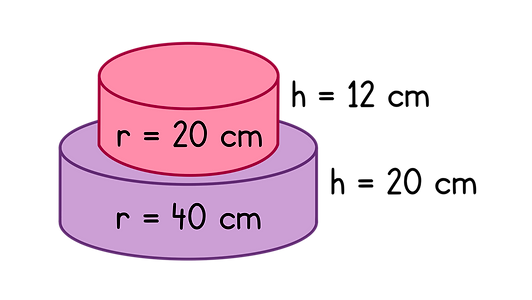
Question 50. Lila’s and Dora’s wedding cake is shaped like two cylinders stacked on each other. Use the given diagram to calculate the cake volume. [2]
Question 51. Find the lowest common multiple of 3, 8 and 24. [1]
Question 52. Convert 0.237777… into the simplest possible fraction. [2]
Question 53. Gary has drawn a square shown in the image that has an area of (w + 2w × 4)². Simplify the area expression. [2]

Question 54. Lara is training for the cross country. She runs it in 18.35 minutes to the nearest 0.01 of a minute. Find the error interval for her time. [2]
Question 55. Estimate the value of √65. [1]
Question 56. Paul has drawn a triangle that has an area of 5 × 10³. Express the value 5 × 10³ as a whole number. [1]

Question 57. Evaluate 27⁴/³ × (2²)¹/². [2]
Question 58. Jane is a chemist who uses algebraic fractions to model chemical reactions. Simplify the fraction (a³ − 3a² + 2a) / (a² − a) she obtained for one of them. [3]

Question 59. A rectangle has sides 3x and 4x + 1. Find a simplified expression for the area of the rectangle. [1]
Question 60. A coin has a radius of 1.20 cm. Given that the formula for the area of a circle is A = πr², calculate the area of the coin. [1]
Question 61. A trapezium’s area can be found using the formula A = h(a + b)/2, where h is the height and a and b are the lengths of the parallel sides of the trapezium. Make h the subject of the formula. [1]
Question 62. Let f(x) = x + 2 and g(x) = x² − 1. Find fg(2). [1]
Question 63. Solve the following equation: w ÷ 5 − 2 = 4. [1]
Question 64. Find the values of a and b such that 2b = 3a and a² + b = 10. [3]
Question 65. Alex is planning to launch a startup. He wants to calculate the break-even points to understand the business's financial viability by solving 2x² + x − 10 = 0. Find the values of x that satisfy this equation. [2]
Question 66. Given that x satisfies the inequalities x > 10 and x < −3, express this as a quadratic inequality. [2]
Question 67. Sarah has chosen an initial guess of x₀ = 2 to solve the equation x = 1 − x³ using iteration. Predict the value of x₁ she would calculate in the first iteration. [1]
Question 68. x is directly proportional to y. Given that x = 10 when y = 2, construct an equation for the relationship of x and y. [1]
Question 69. A headmaster has found the ratio of international to non-international students in a school to be 1 : 5. Given that there are 1200 students in the school, calculate the number of non-international students. [1]

Question 70. In a cake mixture, the ratio of cups of flour to sugar is given by 1 : 2. Given that Anna wants to make a cake from 6 cups of ingredients, calculate how many cups of flour and sugar she will need. [1]
Question 71. A shop has an ongoing sale of 40% off. Given that the current reduction to the price of a T-shirt is £12, calculate the full price of the T-shirt. [1]
Question 72. Anna has £200 in a bank account which accrues simple interest of 4% every year. Calculate the total amount she will have in 4 years. [1]
Question 73. Given that x and y are inversely proportional such that when x = 7, y = 3, calculate the gradient of the graph of x against 1/y. [1]
Question 74. Hannah jogs for 50 seconds at 2 m/s and then for 50 seconds at 1 m/s. Find her mean speed during the jog. [3]
Question 75. Ibrahim is trying to find the density of a block of aluminium in kg/m³. Given that the density is 2.7 g/cm³, calculate the value in the units Ibrahim wants to use. [1]
Question 76. Describe the geometric relationship between the straight lines given by y = 7x + 3 and 14y + 2x = 28. [2]
Question 77. Explain why the graph of tangent has asymptotes. [1]
Question 78. A square with vertices at (0, 0), (1, 0), (0, 1) and (1, 1) undergoes a translation of 1 unit to the right and 5 units up. State the new coordinates of the vertices of the square. [1]
Question 79. Nadia sketches the graphs of y = x + 1 and y = x² + 3x − 2 on the same set of axes and notes down the points of intersection. Find the equation that the points of intersection will satisfy in the form ax² + bx + c = 0, where a, b and c are given. [1]
Question 80. Predict the 10th term of the quadratic sequence 2, 7, 16, 29, 46, 67, 92, 121, 154, ... [2]
Question 81. Compare vertical line charts and histograms. [2]
Question 82. Describe how to find the modal class in a set of data. [1]
Question 83. Predict the value of the first quartile for a dataset if the median is 40 and the third quartile is 100. [1]
Question 84. Marcus has surveyed a few of his classmates. He first asked each of them how many times per week they exercised. Then he measured their VO₂ max (cardiovascular health measurement). The summarised data are (3, 37), (0, 28), (7, 54), (6, 20), and (4, 42). Which point of the ones provided is an outlier? [1]
Question 85. Name two methods we can use to display the results of a probability experiment. [2]
Question 86. Use the Venn diagram provided to determine two mutually exclusive subjects at the school surveyed. [1]

Question 87. Find the probability of rolling a die twice and getting three both times. [1]
Question 88. Find the size of each angle of a regular pentagon. [2]

Question 89. Describe a sphere in terms of the number of faces, edges and vertices. [1]
Question 90. The volume of a cylinder is enlarged from 120 cm³ to 960 cm³. Given that the diameter of the smaller cylinder is 6 cm, calculate the diameter of the bigger cylinder. [3]
Question 91. A tangent is drawn to a point on a circle. Given that the radius is drawn to that point, what is the angle between the radius and the tangent? [1]
Question 92. A sector of radius 3 has an angle of 40° at the centre. Calculate the area of this sector. [1]
Question 93. A right-angled triangle has two sides of length 3.6 cm and 4.8 cm. Find the length of the hypotenuse. [2]
Question 94. Find the area of the given triangle to 3 significant figures. [3]

Question 95. The diagram displays two right-angled triangles. Calculate the size of the angle x correct to 2 decimal places. [3]

Question 96. Rob has a right-angled piece of card, where the angle opposite a side of 3 cm is 30°. Calculate the length of the hypotenuse of the triangle. [2]
Question 97. An angle of size 45° is subtended by the side of length 6 cm and a side of unknown length in a triangle. Given that the area of the triangle is 3√2 cm², find the unknown length. [2]
Question 98. Show that vectors 3i + 4j and 12i + 16j are parallel. [1]
Question 99. Find the area of a triangle with a base of 5 cm and a height of 8 cm. [1]
Question 100. Find the volume of a cube with a side of 3 cm. [1]
Answer 1. Provide a prime factor decomposition for 275. [1]
Prime factor decomposition can be done by dividing the integer by prime numbers until the number 1 is reached and keeping note of the prime numbers you used. Doing this gives 5 × 5 × 11.
5 × 5 × 11
Answer 2. Give 0.25252525… as a fraction. Simplify the final fraction. [2]
x = 0.252525…
100x = 25.252525…
Subtracting the first from the second equation, 99x = 25.
x = 25/99
[2 marks] 25/99
[1 mark] 99x = 25 or multiplier of 100
Answer 3. Find a simplified expression for f² + (5f − 2f)². [2]
f² + (5f − 2f)² = f² + (3f)² = f² + 9f² = 10f²
[2 marks] 10f²
[1 mark] f² + 9f²
Answer 4. Find the minimum area of a square, given that it has a side of 1 cm to the nearest cm. [2]
The level of accuracy is 1.
Dividing this by 2 gives 0.5.
Lower bound: 1 − 0.5 = 0.5
Minimum area = 0.5 × 0.5 = 0.25 cm²
[2 marks] 0.25 cm²
[1 mark] 0.5
Answer 5. Simplify the following expression: √12 ÷ √4 × √2. [1]
√12 ÷ √4 × √2 = √(12 ÷ 4) × √2 = √3 × √2 = √(3 × 2) = √6
√6
Answer 6. Calculate the value of 1.3 × 10². [1]
1.3 × 10² = 1.3 × 10 × 10 = 130
130
Answer 7. Given that 25² × 5ˣ ÷ 125 = 625, find x. [2]
25² × 5ˣ ÷ 125 = 625
25² × 5ˣ ÷ 125 = 5⁴
(5²)² × 5ˣ ÷ 5³ = 5⁴
5⁴ × 5ˣ ÷ 5³ = 5⁴ by the power rule
Using the multiplication and division rule, 4 + x − 3 = 4
1 + x = 4
x = 3
[2 marks] 3
[1 mark] 5³ or 5⁴ × 5ˣ ÷ 5³ = 5⁴
Answer 8. Simplify the algebraic fraction (x² − 6x + 8) / (x − 2). [2]
We factorise the numerator: x² − 6x + 8 = (x − 2)(x − 4). Then, we cancel out the common factor (x − 2) between the numerator and denominator. The simplified fraction is: ((x − 2)(x − 4)) / (x − 2) = x − 4.
[2 marks] x − 4
[1 mark] (x − 2)(x − 4)
Answer 9. Expand (2x + 1)(3x + 7). [1]
(2x + 1)(3x + 7) =
= 2x × 3x + 2x × 7 + 1 × 3x + 1 × 7 =
= 6x² + 14x + 3x + 7 =
= 6x² + 17x + 7
6x² + 17x + 7
Answer 10. Compare formulas and equations. [2]
The difference between a formula and an equation is that an equation may have solutions and work for specific values of the variables, whereas formulae can be used to calculate quantities for any value of the other variables.
[1 mark] formula: for calculating quantities
[1 mark] equation: potential solutions
Answer 11. A kinematic formula is v² = u² + 2as, where v is final velocity, u is initial velocity, a is acceleration and s is displacement. Rearrange this formula to make acceleration the subject. [1]
v² = u² + 2as
Subtracting u² from both sides, v² − u² = 2as.
Switching both sides around, 2as = v² − u².
Dividing both sides by 2s, a = (v² − u²)/2s.
a = (v² − u²)/2s
Answer 12. Find the inverse function of f(x) = 3/(x² + 5). [2]
f(x) = 3/(x² + 5)
Expressing the function in terms of y, y = 3/(x² + 5).
Interchanging x and y, x = 3/(y² + 5).
Multiplying both sides by y² + 5, x(y² + 5) = 3.
Dividing both sides by x, y² + 5 = 3/x.
Subtracting 5 from both sides, y² = 3/x − 5.
Taking the root of both sides, y = √(3/x − 5).
[2 marks] √(3/x − 5)
[1 mark] y² + 5 = 3/x
Answer 13. Find the value of x such that 3(x + 2) = 12. [1]
3(x + 2) = 12
By expanding the brackets, 3x + 6 = 12.
Subtracting 6 from both sides, 3x = 6.
Dividing both sides by 3, x = 2.
2
Answer 14. Donald buys 3 bananas and 2 apples and pays £1.80. When he buys 5 bananas and 1 apple, he pays £2.30. Find the cost of one banana and the cost of one apple. [3]
Let a = the cost of an apple and b = the cost of a banana.
3b + 2a = 1.8 and 5b + a = 2.3
Rearranging the second equation, a = 2.3 − 5b.
Substituting this into the first equation, 3b + 2(2.3 − 5b) = 1.8.
3b + 4.6 − 10b = 1.8
2.8 = 7b
b = 0.4
Substituting this into the equation for a = 2.3 − 5 × 0.4 = 0.3.
[3 marks] apple: 0.3, banana: 0.4
[1 mark] apple: 30p or 0.3
[1 mark] banana: 40p or 0.4
[1 mark] 3b + 2a = 1.8, 5b + a = 2.3
Answer 15. Solve x² − 4x − 40 = 0. [3]
x² − 4x − 40 = 0
Completing the square gives (x − 2)² − 2² − 40 = 0.
Simplifying gives (x − 2)² − 44 = 0.
Adding 44 to both sides, (x − 2)² = 44.
Taking the root of both sides, x − 2 = ±√44.
Simplifying gives x − 2 = ±2√11.
Adding 2 to both sides, x = 2 ± 2√11.
[3 marks] 2 ± 2√11
[2 marks only] (x − 2)² = 44 or 2 ±√44
[1 mark] (x − 2)² (...)
Answer 16. Gino owns x number hats. Triple the number of hats Gino owns is greater than the number he would own if he had eight more than he has now. State the possible set of values for x. [2]
3x > x + 8
3x − x > 8
2x > 8
x > 4
[2 marks] x > 4
[1 mark] 3x > x + 8
Answer 17. Using the iterative method, Oliver obtained x₂ after two iterations while solving the equation 3x² + 6x + 12 = 0. Describe the steps he might have taken to arrive at this value. [2]
Oliver is solving the equation 3x² + 6x + 12 = 0 using iteration and obtained x₂ = 1.5 after two iterations. For this to happen, Oliver would first need to rearrange the equation to the form x = g(x). A possible rearrangement could be x = √((12 − 6x) / 3) = √(4 − 2x). After this, Oliver would have chosen an initial value for x, say x₀. He would have substituted this initial value into the rearranged equation to get x₁. Then, he substituted x₁ into the rearranged equation to get x₂.
[1 mark] x = √(4 − 2x) or x = −0.5x² − 2
[1 mark] two iterations by substitution
Answer 18. z is directly proportional to s². Given that when s = 3, z = 54, construct an equation for the relationship between z and s². [1]
Since z is directly proportional to s², z = ks², where k is a constant of proportionality.
Substituting s = 3, z = 54 into this gives 54 = k(3²), thus k = 6.
Therefore, z = 6s².
z = 6s²
Answer 19. For every dog in an animal shelter, there are two cats. State the fraction of cats in the animal shelter. [1]
The ratio of dogs to cats is 1 : 2.
fraction of cats = 2/(1 + 2) = 2/3
2/3
Answer 20. Anna wants to split £300 between two of her accounts in the ratio 1 : 2. Calculate the amount that each bank account will get. [1]
total number of parts = 1 + 2 = 3
£300 ÷ 3 = £100 per part
The first account will get 1 × 100 = £100.
The second account will get 2 × 100 = £200.
£100, £200
Answer 21. Write down 4/25 as a percentage. [1]
4/25 = 16/100, therefore 16%.
16%
Answer 22. Beth has made an investment of £7000. Given that it accrues compound interest of 3% every year, calculate the value of her investment in 4 years. [2]
Using the formula for compound interest, A = 7000(1 + 3% ÷ 100%)⁴ = £7878.56 (to 2 d. p.).
[2 marks] £7878.56
[1 mark] 7878.56 or 7000(1 + 3% ÷ 100%)⁴ or 1.03
Answer 23. The number of meat-eaters a restaurant hosts daily is inversely proportional to the number of vegetarian dishes they make. Given that when they host 15 meat-eaters, they make 4 vegetarian dishes, calculate the number of vegetarian dishes they will make when they get 20 meat-eaters. [2]
Let x = the number of meat-eaters they host in a day and y = the number of vegetarians they host in a day.
Since x and y are inversely proportional, x = k/y, where k is a constant of proportionality.
Substituting x = 15, y = 4 into this gives 15 = k/4, thus k = 60.
Therefore, the equation is given by x = 60/y.
When x = 20, y = 60/20 = 3 vegetarian dishes.
[2 marks] 3
[1 mark] 60
Answer 24. A bumblebee flies 100 m at 2.5 m/s and then 50 m at 5 m/s. Calculate the mean speed of the bumblebee. [3]
For the bumblebee's mean speed, we note that the total distance flown is 150 m (100 m + 50 m). To calculate the total time, we divide the distance by the speed for each segment: 100 m ÷ 2.5 m/s is 40 seconds, and 50 m ÷ 5 m/s equals 10 seconds. By summing these times, the bumblebee spends a total of 50 seconds in flight. Thus, calculating the mean speed by dividing the total distance by the total time, we find the bumblebee's mean speed to be 3 m/s.
[3 marks] 3 m/s
[2 marks only] 3
[1 mark] 50
[1 mark] 150
Answer 25. Rachel wants to calculate the density of water in g/cm³. Given that the density of water is 997 kg/m³, derive the value Rachel is looking for. [1]
density = (997 × 1000)/(1 × 100³) = 0.997 g/cm³
0.997 g/cm³
Answer 26. State the conditions for two lines to be perpendicular to each other. [1]
The product of the gradients of two perpendicular lines is −1.
Product of gradients is −1.
Answer 27. Find the points of intersection of the line y = 3x + 5 and the circle centred at the origin with radius 5. [3]
The equation of the circle is given by x² + y² = 25.
The points of intersection can be found by solving the two equations simultaneously by substitution.
x² + (3x + 5)² = 25
x² + 9x² + 30x + 25 = 25
10x² + 30x = 0
x² + 3x = 0
x(x + 3) = 0
x = 0 or x = −3
y = 3 × 0 + 5 = 5 or y = 3 × −3 + 5 = −4
[3 marks] (0, 5), (−3, −4)
[1 mark] y = 5, y = −4
[1 mark] x = 0, x = −3
[1 mark] x² + y² = 25
Answer 28. State the new coordinates for the point (9, 4) after we translate it by a vector (−2 5). [1]
The top number represents the number of units moved in the horizontal direction, with the positive direction being the right direction. The bottom number represents the number of units moved in the vertical direction, with the positive direction being upwards.
9 − 2 = 7
4 + 5 = 9
(7, 9)
Answer 29. Complete the square of the following expression: x² + 6x + 11. [2]
x² + 6x + 11 = (x + 6/2)² − (6/2)² + 11/1
= (x + 3)² − 3² + 11
= (x + 3)² − 9 + 11
= (x + 3)² + 2
[2 marks] (x + 3)² + 2
[1 mark] (x + 3)² ...
Answer 30. Describe the relationship between consecutive terms in an arithmetic sequence. [1]
In an arithmetic sequence, the relationship between consecutive terms is that they have a constant difference.
constant difference
Answer 31. Name the type of diagram provided in the image. [1]
A graph with bars to represent different values or categories is called a bar chart. The diagram provided is a bar chart.
bar chart
Answer 32. Twenty volunteers have been cleaning a beach. Each of them has collected the following amount of rubbish in kilograms: 7, 4, 3, 2, 5, 2, 7, 5, 4, 3, 6, 5, 5, 4, 7, 3, 8, 4, 6, 5. Find the modal mass of rubbish collected by a volunteer. [1]
We need to identify the most frequent value in the data set to find the modal mass of rubbish collected by a volunteer. From the data, 5 kilograms is the mode of the data set. Therefore, the modal mass of rubbish collected by a volunteer is 5 kg.
5
Answer 33. Find the third quartile for 8, 3, 6, 4, 7, 3, 2, 8, 5, 9, 4, 9, 2, 1, 7, 4, 9, 4. [1]
To find the third quartile (Q3) for 8, 3, 6, 3, 2, 8, 5, 9, 9, 2, 1, 4, 9, 4, we first need to put the data in order: 1, 2, 2, 3, 3, 4, 4, 4, 4, 5, 6, 7, 7, 8, 8, 9, 9, 9. The third quartile (Q3) represents the upper 25% of the data or the 75th percentile. So we count off 75% of the data and get 8 as Q3.
8
Answer 34. Name the type of correlation in the graph provided. [1]
There is an overall downward trend in the graph. So when one variable increases but the other decreases, that's a negative correlation.
negative
Answer 35. A coin flip with one trial returns an experimental probability of 0% or 100%. How can we change the experiment to get the probability that is closer to 50%? [1]
Experimental probability tends to approach theoretical probability with more trials because the results become more consistent as the number of trials increases. Therefore, the more trials we conduct, the closer the experimental probability will be to the theoretical one.
more trials
Answer 36. Find the probability of rolling a die to get a number that is not 6. Give your answer as a fraction. [1]
The probability of rolling a die to get a number that is not six is 5/6, as there are five possible outcomes out of 6 that are not 6.
5/6
Answer 37. What is the probability that four coin flips return exactly two tails and two heads in any order? [2]
To find the probability of getting two tails and two heads in any order, we need to think about how many possible outcomes there are when we flip a coin four times. Each flip has two possible outcomes (heads or tails), so the total number of outcomes is 2 × 2 × 2 × 2 = 16. We can list all these outcomes and count how many have two tails and two heads in any order. There are six such outcomes: HHTT, HTHT, HTTH, THHT, THTH, and TTHH. So the probability of getting two tails and two heads in any order is 6/16, which simplifies to 3/8.
[2 marks] for 3/8
[1 mark] for 6 or 16 or 1/16
Answer 38. Calculate the value of θ. [1]
θ lies on a straight line with an angle that is an alternate angle pair with the 60° angle.
The angle next to θ is 60°.
The sum of the angles on a straight line is 180°.
θ + 60 = 180
θ = 180 − 60 = 120°
120°
Answer 39. Explain why a cylinder has 2 edges but no vertices. [1]
The two edges of a cylinder are the arcs of the base circles. Since these two edges do not touch, the cylinder does not have any vertices.
Its edges do not touch.
Answer 40. A triangle is enlarged by a scale factor of 3. Explain the relationship between the old triangle and the new triangle. [1]
There is a consistent ratio between corresponding sides of the triangles, since the second was created by an enlargement, therefore the two triangles are of the same shape but different size. The two triangles are similar.
similar
Answer 41. Explain why the angle subtended at the circumference by a semicircle is 90°. [2]
The angle at the centre of the circle formed by the semicircle is 180° since it is a straight line. By the standard circle theorems, the angle subtended at the centre of a circle by an arc is twice the size of the angle subtended at the circumference. Therefore, the angle at the circumference is 180° ÷ 2 = 90°.
[1 mark] The angle at the centre of the circle is 180°.
[1 mark] The angle subtended at the circumference is half the one at the centre.
Answer 42. Calculate the area of a circle with a radius of 6 cm rounded to cm². [1]
A = πr²
A = π × 6² = 36π = 113 cm² (to 3 s. f.)
113 cm²
Answer 43. Lola draws a triangle with a hypotenuse of √18 cm. Given that the other two sides of the triangle are equal, calculate the length of these sides. [2]
Let x = the length of one of the sides.
By Pythagoras’ theorem, x² + x² = (√18)².
2x² = 18
x² = 9
x = 3 cm
[2 marks] 3 cm
[1 mark] 3 or x² + x² = (√18)²
Answer 44. Zain is making a garland out of triangles. Each triangle has two sides of 8 cm and 10 cm and an angle of 60° opposite a side of unknown length. Calculate the length of the third side. [2]
By the cosine rule, a² = b² + c² − 2bccosA.
a² = 10² + 8² − 2 × 10 × 8 × cos(60°)
a² = 84
a = √84 = 2√21 cm
[2 marks] 2√21 cm
[1 marks] 2√21 or 9.17 or a² = 10² + 8² − 2 × 10 × 8 × cos(60°)
Answer 45. Mary is cutting a piece of cardboard into a right-angle triangle to make a birthday card. She wants an angle of 45° opposite a side of 4 cm. Find the length of the adjacent side. [1]
tanx = opposite ÷ adjacent
tan(45°) = 4 cm ÷ adjacent
adjacent = 4 cm ÷ tan(45°)
adjacent = 4 cm ÷ 1
adjacent = 4 cm
4 cm
Answer 46. Malika and her husband bought a triangular corner table with a right angle. Given that it has a hypotenuse of 4 cm and an angle of 45°, calculate the length of the side adjacent to the angle. [3]
cosx = adjacent ÷ hypotenuse
cos(45°) = adjacent ÷ 4 cm
adjacent = cos(45°) × 4 cm
adjacent = 1/√2 × 4 cm
adjacent = 2√2 cm
[3 marks] 2√2 cm
[2 marks only] 2√2
[1 mark] 1/√2
[1 mark] cos(45°) = a/4
Answer 47. A triangle has an angle of 40° and an angle of 70°. Given that the sides subtending the unknown angle have 8 cm and 10 cm lengths, calculate the triangle area rounded to cm². [2]
The sum of the angles in a triangle is 180°.
40° + 70° + θ = 180°
θ = 180° − 70° − 40°
θ = 70°
Area = 1/2 × absinC
Area = 1/2 × 8 cm × 10 cm × sin(70°)
Area = 38 cm² (to 2 s. f.)
[2 marks] 38 cm²
[1 mark] 38 or 70
Answer 48. Simplify (1 4 2) − 2(1 1 1) + (4 7 2). [1]
(1 4 2) − 2(1 1 1) + (4 7 2) =
= (1 4 2) − (2 2 2) + (4 7 2) =
= (3 9 2)
(3 9 2)
Answer 49. What is the area of a trapezium with bases of length 3 cm and 7 cm and a vertical height of 10 cm? [1]
A = (a + b)/2 × h
A = (3 + 7)/2 × 10 = 50 cm²
50 cm²
Answer 50. Lila’s and Dora’s wedding cake is shaped like two cylinders stacked on each other. Use the given diagram to calculate the cake volume. [2]
volume of cylinder = πr²h
first volume = π × 40² × 20
first volume = 32000π
second volume = π × 20² × 12
second volume = 4800π
Total volume = 4800π + 32000π = 36800π cm³
[2 marks] 36800π cm³
[1 mark] 36800π or 115610 or 4800π or 32000π
Answer 51. Find the lowest common multiple of 3, 8 and 24. [1]
Multiples of 3: {3, 6, 9, 12, 15, 18, 21, 24, ...}
Multiples of 8: {8, 16, 24, ...}
Multiples of 24: {24, 48, ...}
The LCM of the three numbers is 24.
24
Answer 52. Convert 0.237777… into the simplest possible fraction. [2]
There is 1 digit recurring; thus, a multiplier of 10 can be used.
x = 0.237777…
10x = 2.377777..
Subtracting the first from the second equation, 9x = 2.14
x = 2.14/9 = 214/900 = 107/450
[2 marks] 107/450
[1 mark] 9x = 2.14 or multiplier of 10
Answer 53. Gary has drawn a square shown in the image that has an area of (w + 2w × 4)². Simplify the area expression. [2]
(w + 2w × 4)² = (w + 8w)² = (9w)² = 81w²
[2 marks] 81w²
[1 mark] 9w or (9w)²
Answer 54. Lara is training for the cross country. She runs it in 18.35 minutes to the nearest 0.01 of a minute. Find the error interval for her time. [2]
Let t be the time taken.
The level of accuracy is 0.01.
Dividing this by 2 gives 0.005.
Upper bound: 18.35 + 0.005 = 18.355
Lower bound: 18.35 − 0.005 = 18.345
Therefore, 18.345 ≤ 18.35 < 18.355.
[2 marks] 18.345 ≤ x < 18.355
[1 mark] 18.345 or 18.355 or 0.01 or 0.005
Answer 55. Estimate the value of √65. [1]
8 × 8 = 64 and 9 × 9 = 81.
Therefore, √64 = 8 and √81 = 9, and √65 lies between 8 and 9.
Since 65 is closer to 64 than 81, √65 must be closer to 8. An appropriate estimate is 8.1.
between 8 and 9, closer to 8
Answer 56. Paul has drawn a triangle that has an area of 5 × 10³. Express the value 5 × 10³ as a whole number. [1]
5 × 10³ = 5 × 10 × 10 × 10 = 5000
5000
Answer 57. Evaluate 27⁴/³ × (2²)¹/². [2]
27⁴/³ × (2²)¹/² = (³√27)⁴ × (2²)¹/²
= 3⁴ × 2²/² using the power rule
= 81 × 2
= 162
[2 marks] 162
[1 mark] 81 or 2
Answer 58. Jane is a chemist who uses algebraic fractions to model chemical reactions. Simplify the fraction (a³ − 3a² + 2a) / (a² − a) she obtained for one of them. [3]
To simplify the fraction (a³ − 3a² + 2a) / (a² − a), we factorise the numerator and denominator: numerator: a³ − 3a² + 2a = a(a² − 3a + 2) = a(a − 1)(a − 2); denominator: a² − a = a(a − 1). We cancel out the common factors a and (a − 1) between the numerator and the denominator. The simplified fraction is: a(a − 1)(a − 2) / a(a − 1) = a − 2.
[3 mark] a − 2
[1 mark] a(a − 1)(a − 2)
[1 mark] a(a − 1)
Answer 59. A rectangle has sides 3x and 4x + 1. Find a simplified expression for the area of the rectangle. [1]
Area = 3x(4x + 1)
= 3x × 4x + 3x × 1
= 12x² + 3x
12x² + 3x
Answer 60. A coin has a radius of 1.20 cm. Given that the formula for the area of a circle is A = πr², calculate the area of the coin. [1]
Area = π × 1.20² = 1.44π cm²
1.44π cm²
Answer 61. A trapezium’s area can be found using the formula A = h(a + b)/2, where h is the height and a and b are the lengths of the parallel sides of the trapezium. Make h the subject of the formula. [1]
A = h(a + b)/2
Multiplying both sides by 2, 2A = h(a + b).
Dividing both sides by (a + b), h = 2A/(a + b).
h = 2A/(a + b)
Answer 62. Let f(x) = x + 2 and g(x) = x² − 1. Find fg(2). [1]
g(2) = 2² − 1 = 3
f(3) = 3 + 2 = 5
5
Answer 63. Solve the following equation: w ÷ 5 − 2 = 4. [1]
w ÷ 5 − 2 = 4
Adding 2 to both sides, w ÷ 5 = 6.
Multiplying both sides by 5, w = 30.
30
Answer 64. Find the values of a and b such that 2b = 3a and a² + b = 10. [3]
Since 2b = 3a, b = 3a/2.
Substituting this into the second equation, a² + 3a/2 = 10.
Multiplying both sides by 2 gives 2a² + 3a − 20 = 0.
Factorising gives (2a − 5)(a + 4) = 0.
2a − 5 = 0 or a + 4 = 0
a = 5/2 or a = −4
Substituting this into b = 3a/2, b = 15/4 or b = −6
[3 marks] (a = 5/2, b = 15/4 or a = −4, b = −6)
[1 mark] (a = 5/2 or a = −4)
[1 mark] (b = 15/4 or b = −6)
Answer 65. Alex is planning to launch a startup. He wants to calculate the break-even points to understand the business's financial viability by solving 2x² + x − 10 = 0. Find the values of x that satisfy this equation. [2]
Using the quadratic formula when a = 2, b = 1 and c = −10:
x = (−b ± √(b² − 4ac))/(2a)
x = (−1 ± √(1² − 4 × 2 × (−10)))/(2 × 2)
x = (−1 ± √(1 − 4 × 2 × (−10)))/(2 × 2)
x = (−1 ± √(1 − 8 × (−10)))/(2 × 2)
x = (−1 ± √(1 − 8 × (−10)))/4
x = (−1 ± √(1 + 80))/4
x = (−1 ± √81)/4
x = (−1 ± 9)/4
x₁ = −2.5, x₂ = 2
[2 marks] x₁ = −2.5, x₂ = 2
[1 mark only] (x − 2)(2x + 5)
[1 mark only] (−1 ± √(1² − 4 × 2 × (−10)))/(2 × 2)
Answer 66. Given that x satisfies the inequalities x > 10 and x < −3, express this as a quadratic inequality. [2]
The root of the equivalent quadratic equation are x = 10 and x = −3.
The equivalent quadratic equation is thus given by (x − 10)(x + 3) = 0.
x² − 7x − 30 = 0
Since the inequalities specify the part of the graph that is above the x-axis, this is given by x² − 7x − 30 > 0.
[2 marks] x² − 7x − 30 > 0
[1 mark] (x − 10)(x + 3) or x² − 7x − 30
Answer 67. Sarah has chosen an initial guess of x₀ = 2 to solve the equation x = 1 − x³ using iteration. Predict the value of x₁ she would calculate in the first iteration. [1]
To calculate the next iteration, x₁, she will substitute x₀ into the right-hand side of her equation. So, x₁ = 1 − (2³) = 1 − 8 = −7. This is the value Sarah would get for x₁ in her first iteration.
−7
Answer 68. x is directly proportional to y. Given that x = 10 when y = 2, construct an equation for the relationship of x and y. [1]
Since x is directly proportional to y, x = ky, where k is a constant of proportionality.
Substituting y = 2, x =10 into this gives 10 = k × 2, therefore k = 5.
Thus, the equation is given by x = 5y.
x = 5y
Answer 69. A headmaster has found the ratio of international to non-international students in a school to be 1 : 5. Given that there are 1200 students in the school, calculate the number of non-international students. [1]
fraction of non-international students = 5/(1 + 5) = 5/6
number of non-international students = 5/6 × 1200 = 1000
1000
Answer 70. In a cake mixture, the ratio of cups of flour to sugar is given by 1 : 2. Given that Anna wants to make a cake from 6 cups of ingredients, calculate how many cups of flour and sugar she will need. [1]
total number of parts = 1 + 2 = 3
6 ÷ 3 = 2 cups per part
cups of flour = 1 × 2 = 2
cups of sugar = 2 × 2 = 4
2, 4
Answer 71. A shop has an ongoing sale of 40% off. Given that the current reduction to the price of a T-shirt is £12, calculate the full price of the T-shirt. [1]
12 ÷ 40 = £0.30 is equivalent to 1%.
Multiplying by 100 gives £30 to be equivalent to 100% of the value.
£30
Answer 72. Anna has £200 in a bank account which accrues simple interest of 4% every year. Calculate the total amount she will have in 4 years. [1]
Using the formula for simple interest, r = 4 ÷ 100 and t = 4.
total amount = 200(1 + 4 × 4% ÷ 100%) = £232
£232
Answer 73. Given that x and y are inversely proportional such that when x = 7, y = 3, calculate the gradient of the graph of x against 1/y. [1]
Since x is inversely proportional to y, x = k/y, where k is a constant of proportionality.
Substituting y = 3, x = 7 into this gives 7 = k/3, therefore k = 21.
Thus, the equation is given by x = 21/y.
Plotting x against 1/y is a straight line with gradient 21.
21
Answer 74. Hannah jogs for 50 seconds at 2 m/s and then for 50 seconds at 1 m/s. Find her mean speed during the jog. [3]
In calculating Hannah's mean speed during her jog, we first ascertain the total distance she jogs. By multiplying the time and speed for each segment, we get 50 seconds × 2 m/s equals 100 m, and 50 seconds × 1 m/s yields 50 m. Adding these together, Hannah covers a total distance of 150 m. The total time is the sum of 50 seconds and 50 seconds, amounting to 100 seconds. Thus, by dividing the total distance by the total time, we calculate that Hannah's mean speed during the jog is 1.5 m/s.
[3 marks] 1.5 m/s
[2 marks only] 1.5
[1 mark] 100
[1 mark] 150
Answer 75. Ibrahim is trying to find the density of a block of aluminium in kg/m³. Given that the density is 2.7 g/cm³, calculate the value in the units Ibrahim wants to use. [1]
density = (2.7 ÷ 1000)/(1 ÷ 100³) = 2700 kg/m³
2700 kg/m³
Answer 76. Describe the geometric relationship between the straight lines given by y = 7x + 3 and 14y + 2x = 28. [2]
The gradient of y = 7x + 3 is 7.
14y + 2x = 28
y + x/7 = 2
y = −x/7 + 2
The gradient of 14y + 2x = 28 is −1/7.
7 × −1/7 = −1, therefore the two lines are perpendicular.
[2 marks] perpendicular
[1 mark] −1/7
Answer 77. Explain why the graph of tangent has asymptotes. [1]
Tangent is undefined for odd multiples of 90°, therefore for those x values, the graph will not have a point, thus it has asymptotes there.
Tangent is undefined at odd multiples of 90°.
Answer 78. A square with vertices at (0, 0), (1, 0), (0, 1) and (1, 1) undergoes a translation of 1 unit to the right and 5 units up. State the new coordinates of the vertices of the square. [1]
Change in the x coordinate here represents horizontal motion, while change in the y coordinate corresponds to vertical translation. To get new vertices for the square, we add 1 to each of the y coordinates in the point notation, and we add 5 to the x coordinates. (0 + 1, 0 + 5), (1 + 1, 0 + 5), (0 + 1, 1 + 5) and (1 + 1, 1 + 5) gives (1, 5), (2, 5), (1, 6) and (2, 6).
(1, 5), (2, 5), (1, 6), (2, 6)
Answer 79. Nadia sketches the graphs of y = x + 1 and y = x² + 3x − 2 on the same set of axes and notes down the points of intersection. Find the equation that the points of intersection will satisfy in the form ax² + bx + c = 0, where a, b and c are given. [1]
x + 1 = x² + 3x − 2
x² + 2x − 3 = 0
x² + 2x − 3 = 0
Answer 80. Predict the 10th term of the quadratic sequence 2, 7, 16, 29, 46, 67, 92, 121, 154, ... [2]
The first difference is 7 − 2 = 5.
The second difference is 16 − 7 = 9.
The third difference is 29 − 16 = 13.
The fourth difference is 46 − 29 = 17.
The fifth difference is 67 − 46 = 21.
The sixth difference is 92 − 67 = 25.
The seventh difference is 121 − 92 = 29.
The eighth difference is 154 − 121 = 33.
We can see that the difference between consecutive terms increases by 4 each time. Therefore, the difference between the tenth and ninth terms will be 33 + 4 = 37. The ninth term in the sequence is 154, so the tenth term will be 154 + 37 = 191.
[2 marks] 191
[1 mark] 4 or 37
Answer 81. Compare vertical line charts and histograms. [2]
A graph with bars to represent different values or categories is called a bar chart. A vertical line chart is like a bar chart, just with lines instead of bars. A histogram is like a bar chart, but the bars are adjacent, and there are no spaces between them.
[1 mark] presentation of data in both
[1 mark] vertical line: lines, histogram: columns
Answer 82. Describe how to find the modal class in a set of data. [1]
The modal class is a range of values that contains the mode. To find the modal class, find the range of values that has the highest frequency.
Find the range of values with the highest frequency.
Answer 83. Predict the value of the first quartile for a dataset if the median is 40 and the third quartile is 100. [1]
If the median of a dataset is 40 and the third quartile is 100, we can predict that the first quartile (Q1) is less than 40. The reason is that the median (Q2) separates the lowest 50% of the data from the highest 50%. And the third quartile (Q3) represents the upper 25% of the data. Since Q2 is less than Q3, it must be the case that Q1 is also less than Q2.
any value less than 40
Answer 84. Marcus has surveyed a few of his classmates. He first asked each of them how many times per week they exercised. Then he measured their VO₂ max (cardiovascular health measurement). The summarised data are (3, 37), (0, 28), (7, 54), (6, 20), and (4, 42). Which point of the ones provided is an outlier? [1]
One way to identify an outlier is by drawing a line of best fit. Next, we compare each point of the data set to the mean. If a point is significantly away from the line, it is an outlier. Based on this method, we can see that (6, 20) is an outlier, as it falls far away from the general trend of the data points.
(6, 20)
Answer 85. Name two methods we can use to display the results of a probability experiment. [2]
We can use frequency tables and bar charts to display the results of a probability experiment. A frequency table lists the possible outcomes of an experiment and the number of times each outcome occurs. A bar chart is a visual representation of a frequency table and displays the frequency of each outcome as a bar of equal width.
[1 mark] frequency table
[1 mark] bar chart
[1 mark] tree diagram
Answer 86. Use the Venn diagram provided to determine two mutually exclusive subjects at the school surveyed. [1]
Based on the provided Venn diagram, two mutually exclusive subjects at the school surveyed are Physics and Biology.
Physics, Biology
Answer 87. Find the probability of rolling a die twice and getting three both times. [1]
We need to roll a die twice and get three both times. The probability of rolling a three on one die is 1/6. Since the rolls are independent, we can use the rule for independent events to find the chance of both events happening: P(rolling three twice) = P(rolling three on the first roll) × P(rolling three on the second roll) = 1/6 × 1/6 = 1/36.
1/36
Answer 88. Find the size of each angle of a regular pentagon. [2]
The pentagon can be broken down into 3 triangles.
The sum of the angles in a triangle is 180°.
180° × 3 = 540°
540° ÷ 5 = 108°
[2 marks] 108°
[1 mark] 108 or 540
Answer 89. Describe a sphere in terms of the number of faces, edges and vertices. [1]
A sphere has one face, which is the surface of it, no edges and no vertices.
1 face, 0 edges, 0 vertices
Answer 90. The volume of a cylinder is enlarged from 120 cm³ to 960 cm³. Given that the diameter of the smaller cylinder is 6 cm, calculate the diameter of the bigger cylinder. [3]
volume scale factor = 960 cm³ ÷ 120 cm³ = 8
diameter scale factor = ³√8 = 2
diameter = 6 × 2 = 12 cm
[3 marks] 12 cm
[2 marks only] 12 or 2
[1 mark] 8
Answer 91. A tangent is drawn to a point on a circle. Given that the radius is drawn to that point, what is the angle between the radius and the tangent? [1]
The radius at a point is perpendicular to the tangent at that point, therefore the angle between them is 90°.
90°
Answer 92. A sector of radius 3 has an angle of 40° at the centre. Calculate the area of this sector. [1]
area = πr² × 40° ÷ 360°
A = π × 3² × 40° ÷ 360° = π
π
Answer 93. A right-angled triangle has two sides of length 3.6 cm and 4.8 cm. Find the length of the hypotenuse. [2]
Let h = the length of the hypotenuse.
By Pythagoras’ theorem, h² = 3.6² + 4.8².
h² = 12.96 + 23.04
h = √36 = 6 cm
[2 marks] 6 cm
[1 mark] 6 or h² = 3.6² + 4.8²
Answer 94. Find the area of the given triangle to 3 significant figures. [3]
By the cosine rule, cosA = (b² + c² − a²) ÷ 2bc.
cosA = (8² + 9² − 12²) ÷ (2 × 8 × 9)
cosA = 1/144
a = arccos(1/144) = 89.6° (to 3 s. f.)
Area = 1/2 × absinC
Area = 1/2 × 8 cm × 9 cm × sin(89.6°)
Area = 36 cm² (to 2 s. f.)
[3 marks] 36 cm²
[2 marks only] 36 or 89.6
[1 mark] cosA = (8² + 9² − 12²) ÷ (2 × 8 × 9)
Answer 95. The diagram displays two right-angled triangles. Calculate the size of the angle x correct to 2 decimal places. [3]
Consider the triangle on the left.
tan(30°) = opposite ÷ 3 cm
opposite = tan(30°) × 3 cm
opposite = 1.73 cm (to 3 s. f.)
1.73 cm − 0.8 cm = 0.93 cm
Consider the triangle on the right.
sinx = opposite ÷ hypotenuse
sinx = 0.93 cm ÷ 7 cm
x = sin⁻¹(0.93 cm ÷ 7 cm)
x = 7.65° (to 3 s. f.)
[3 marks] 7.65°
[1 mark] 1.73
[1 mark] 0.93
Answer 96. Rob has a right-angled piece of card, where the angle opposite a side of 3 cm is 30°. Calculate the length of the hypotenuse of the triangle. [2]
sinx = opposite ÷ hypotenuse
sin(30°) = 3 cm ÷ hypotenuse
hypotenuse = 3 cm ÷ sin(30°)
hypotenuse = 6 cm
[2 marks] 6 cm
[1 mark] 6 or 0.5 or sin(30°) = 3/h
Answer 97. An angle of size 45° is subtended by the side of length 6 cm and a side of unknown length in a triangle. Given that the area of the triangle is 3√2 cm², find the unknown length. [2]
Let x be the unknown length.
Area = 1/2 × absinC
3√2 cm² = 1/2 × 6 cm × x × sin(45°)
x = 2 cm
[2 marks] 2 cm
[1 mark] 2 or 3√2 = 0.5 × 6xsin(45°)
Answer 98. Show that vectors 3i + 4j and 12i + 16j are parallel. [1]
4 × (3i + 4j) = 12i + 16j; therefore, they are parallel.
4 × (3i + 4j) = 12i + 16j
Answer 99. Find the area of a triangle with a base of 5 cm and a height of 8 cm. [1]
A = bh/2
A = (5 × 8) ÷ 2 = 20 cm²
20 cm²
Answer 100. Find the volume of a cube with a side of 3 cm. [1]
V = 3 × 3 × 3 = 27 cm³
27 cm³
We use AI to draft some of our content. We adapt and attribute it to StudySquare Ltd.